FREE Shipping in Singapore (All Items) | $10 to Malaysia & Brunei | $15 to everywhere else | $60 vis FEDEX or $30 Vis SingPost to USA
* Overseas rate applies to small items only - large items may cost more.
FREE Shipping in Singapore (All Items) | $10 to Malaysia & Brunei | $15 to everywhere else | $60 vis FEDEX or $30 Vis SingPost to USA
* Overseas rate applies to small items only - large items may cost more.
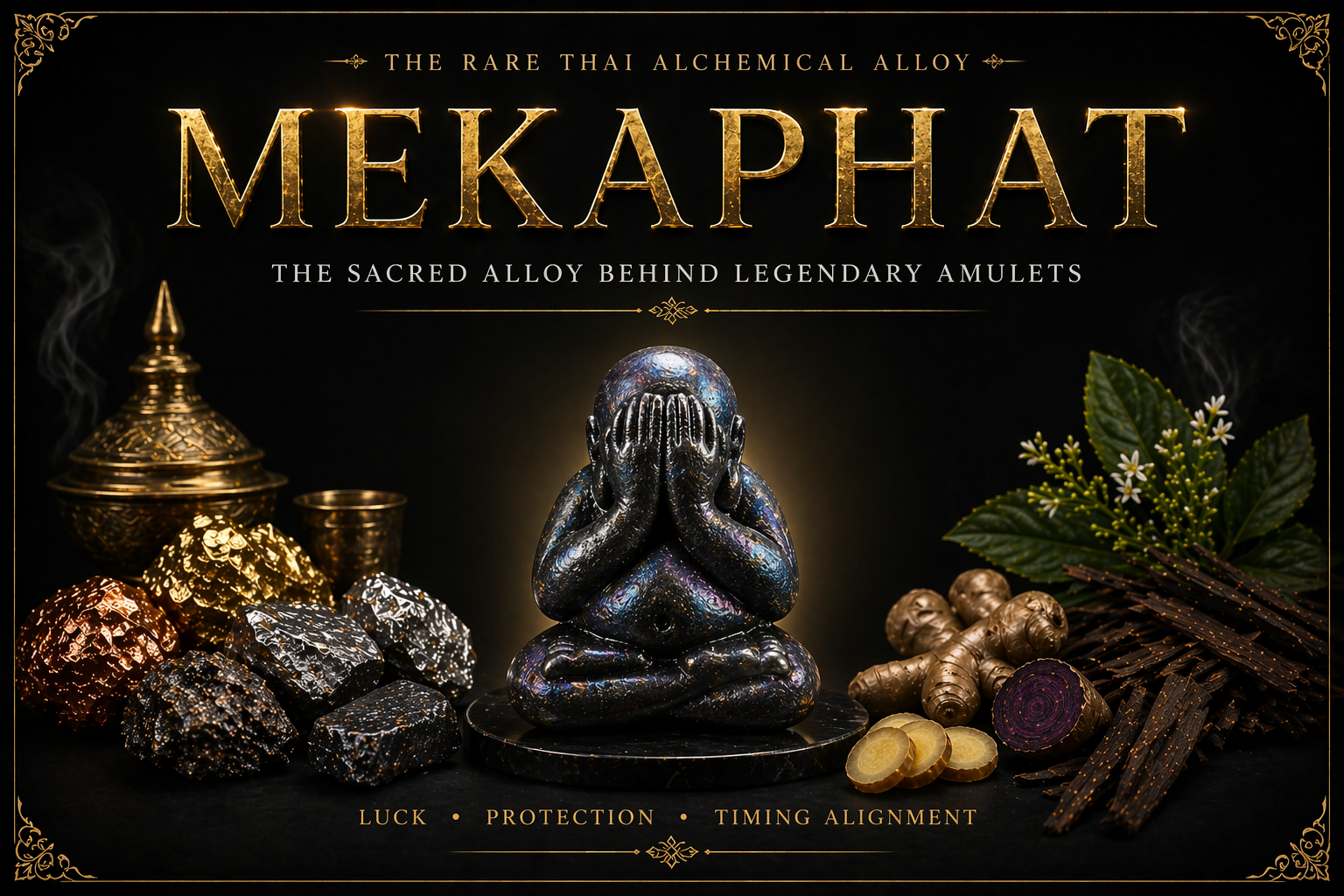
What Is Mekaphat Alloy?
Mekaphat, also known as Nur Mekaphat when used in amulets, stands as one of the most respected alchemical alloys in Thai occult tradition.
It is not an ordinary metal.
Instead, practitioners recognise it as a material formed through a combination of metals, sacred ingredients, and ritual process.
Because of this, Mekaphat carries intrinsic properties even before it is shaped into an amulet.
Traditionally, it is associated with:
- Fortune and favourable timing
- Elevated status and standing
- Protection from harm
As a result, Mekaphat has remained highly sought after across generations, with well-known pieces reaching significant collector value.
Why Mekaphat Is Not Just Ordinary Metal
Mekaphat does not come from simple melting.
Rather, it forms through the controlled amalgamation of multiple metals, followed by sulfur-based treatment at a precise stage.
When the process succeeds, the material develops a dark, glossy surface with a subtle blue-toned gleam.
However, the process demands precision.
If the sequence shifts, if the timing drifts, or if the ritual breaks, the outcome changes completely.
In that case:
The result is no longer Mekaphat — it remains ordinary metal.
For this reason, many replicas exist today.
Although they may look similar, they lack the same traditional value when the process is incomplete.
Materials Used in Mekaphat Alloy
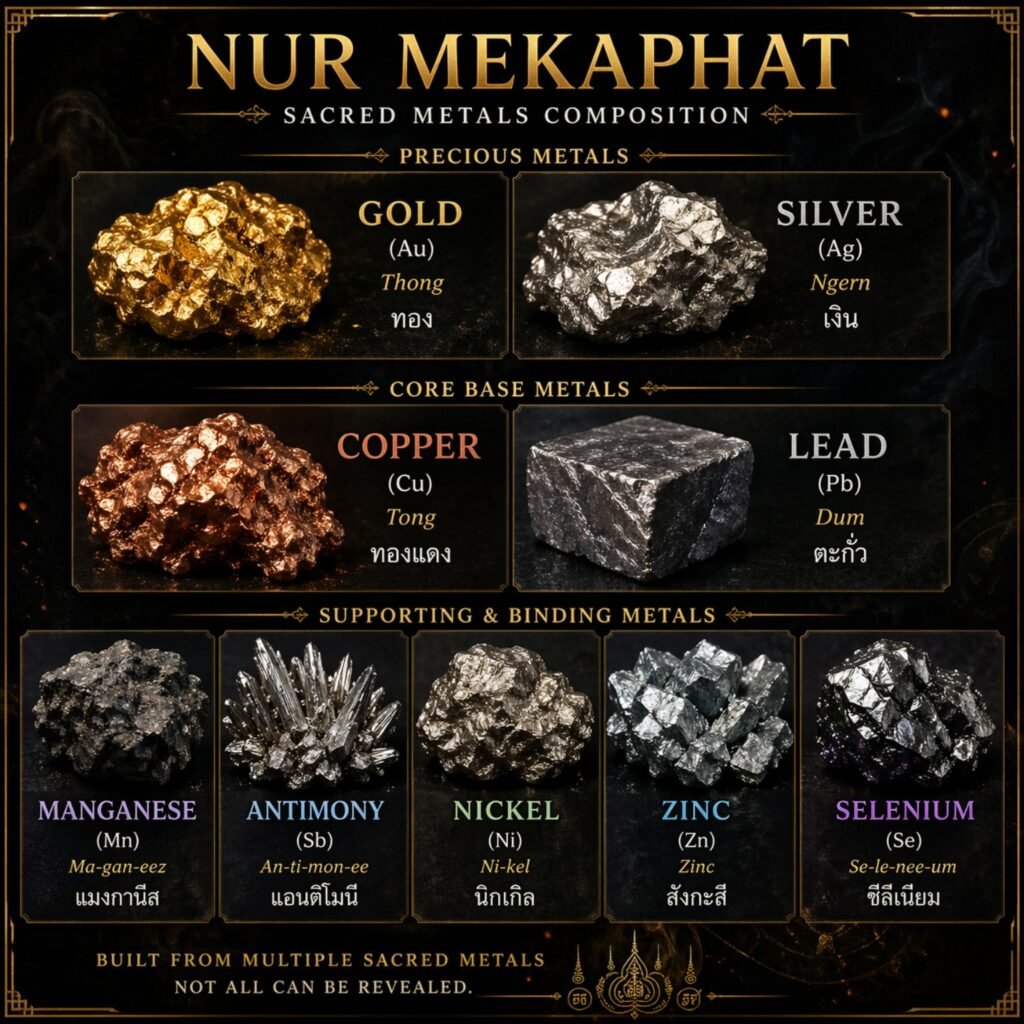
Based on lab analysis referenced in traditional sources, Mekaphat typically relies on:
- Copper
- Lead
These form the main structure.
In addition, smaller amounts of other metals may appear, including:
- Tin
- Manganese
- Antimony
- Gold
- Silver
- Nickel
- Selenium
- Zinc
Importantly, these combinations are not fixed.
Instead, each lineage adjusts:
- proportions
- sequencing
- material selection
Sacred Wan Herbs in Mekaphat
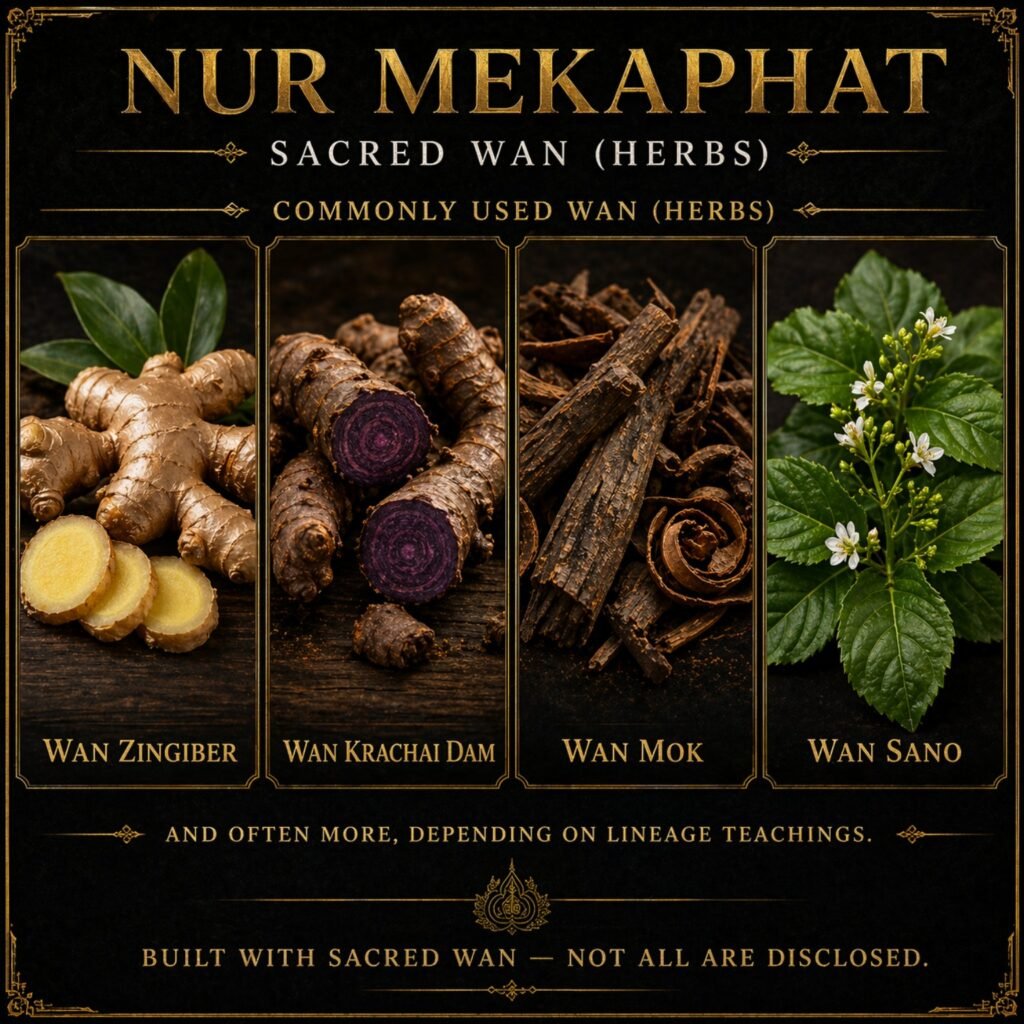
Alongside metals, Mekaphat formulations often include wan (sacred herbs).
Common examples include:
- Zingiber Ottensii Valeton
- Crotalaria species
- Wrightia religiosa (Mok)
- Black Galingale / Stephania venosa
Depending on lineage, additional herbs may also be introduced.
These ingredients do not serve physical properties alone.
Rather, they contribute to:
- energetic balance
- ritual completion
- overall formation of the alloy
No Fixed Recipe — The Role of Lineage
There is no universal formula for Mekaphat.
Instead, each lineage:
- selects its own materials
- determines its own sequence
- preserves its own methods
Even when ingredients are known, replication remains difficult.
Without correct execution, the outcome changes.
Because of this:
Mekaphat depends on process and lineage — not composition alone.
Spiritual Properties of Mekaphat
Traditional descriptions consistently point to three core effects associated with Phra Nur Mekaphat.
1. Noon Duang (Alignment of Fortune)
First, it supports favourable timing.
Opportunities appear more naturally.
Situations align with less resistance.
2. Klaew Klad (Avoidance)
Next, it reduces exposure to danger.
Rather than reacting, one avoids:
- conflict
- risk
- unwanted situations
3. Kongkrapan Chatree (Protection)
Finally, it strengthens protection.
In many accounts, this includes:
- reducing impact
- neutralising harm
- preventing full effect from taking hold
Together, these create a combined effect of:
Alignment, avoidance, and protection working as one system.
Appearance of Mekaphat
Mekaphat typically presents as:
- dark or black in tone
- carrying a subtle blue or indigo gleam
With polishing, its surface may shift slightly.
Over time, older pieces often appear:
- greyish
- muted
- less reflective
However, this change does not reduce value.
Instead, it often reflects age and authenticity.
Mekaphat vs Mekasit
Although often mentioned together, Mekaphat and Mekasit differ clearly.
Mekaphat:
- dark with blue-toned sheen
- copper and lead dominant
In contrast, Mekasit:
- iridescent with shifting colours
- copper and antimony dominant
Because of this, each behaves differently in both appearance and composition.
Why Mekaphat Is Rare
Several factors contribute to its rarity.
First, the process itself remains difficult.
Next, methods are not widely shared.
At the same time, only a small number of practitioners can produce it correctly.
Finally, many original pieces have aged or disappeared.
As a result:
Genuine Mekaphat appears only occasionally.
Despite strong demand, successful production remains limited.
Conclusion
Mekaphat is not defined by what goes into it.
Instead, it is defined by whether the process succeeds.
That distinction separates ordinary metal from something that has been formed, aligned, and completed correctly through knowledge, timing, and discipline.
Because of this, genuine Phra Nur Mekaphat continues to hold weight across generations.
Not because it is widely available.
But because it is not.
And for those who understand it:
It is not something you casually come across.
It is something you recognise when it appears.
🔱𝑺𝒉𝒐𝒈𝒖𝒏𝑿 𝑨𝒎𝒖𝒍𝒆𝒕𝒔
𝑾𝒉𝒆𝒓𝒆 𝒚𝒐𝒖𝒓 𝒔𝒑𝒊𝒓𝒊𝒕𝒖𝒂𝒍 𝒋𝒐𝒖𝒓𝒏𝒆𝒚 𝒃𝒆𝒈𝒊𝒏𝒔
PM/DM now or message directly: https://wa.me/6580444447